
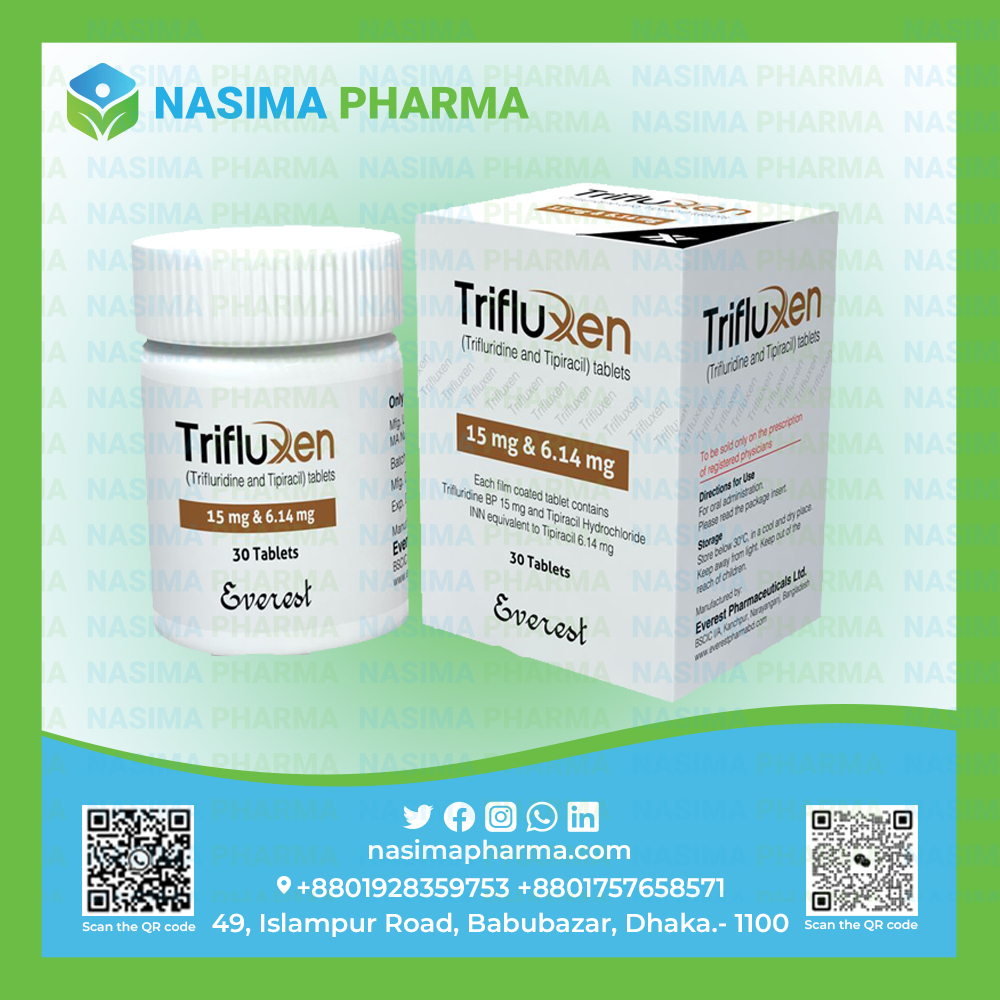
Description
COMPOSITION
Trifluxen tablet: Each film coated tablet contains Trifluridine BP 15 mg and Tipiracil Hydrochloride INN equivalent to Tipiracil 6.14 mg.
PHARMACOLOGY
Mechanism of Action
Trifluridine and Tipiracil consists of a thymidine-based nucleoside analog, Trifluridine, and the thymidine phosphorylase inhibitor, tipiracil, at a molar ratio 1:0.5
(weight ratio, 1:0.471). Inclusion of Tipiracil increases Trifluridine exposure by inhibiting its metabolism by thymidine phosphorylase.
Following uptake into cancer cells, Trifluridine is incorpo- rated into DNA, interferes with DNA synthesis and inhibits
cell proliferation. Trifluridine/Tipiracil demonstrated anti-tumor activity against KRAS wild-type and mutant human colorectal cancer xenografts in mice.
Pharmacokinetic Properties After twice daily dosing of Trifluridine and Tipiracil, system-
ic exposure (AUC) of trifluridine increased more than dose-proportionally over the dose range of 15 mg/m 2 (0.43
times the recommended dose) to 35 mg/m 2 . The accumulation of Trifluridine was 3-fold for AUC 0-12hr
and 2-fold for Cmax at steady state while no accumulation was observed for tipiracil.
Administration of a single dose of Trifluridine and Tipiracil 35 mg/m 2 increased the mean AUC 0-last of Trifluridine by
37-fold and C max by 22-fold with reduced variability compared to administration of a single dose of trifluridine
35 mg/m 2 alone. Absorption
Following a single oral administration of Trifluridine and Tipiracil at 35 mg/m 2 in patients with cancer, the mean time
to peak plasma concentration (T max ) of Trifluridine was
around 2 hours.
Food Effect
A standardized high-fat, high-calorie meal decreased
Trifluridine Cmax , Tipiracil Cmax and AUC by approximately
40%, but did not change Trifluridine AUC compared to
those in a fasting state in patients with cancer following
administration of a single dose of Trifluridine and Tipiracil
35 mg/m 2 .
Distribution
Trifluridine mainly binds to human serum albumin. The in
vitro protein binding of Trifluridine in human plasma is
>96%, independent of drug concentration and presence of
Tipiracil. Plasma protein binding of Tipiracil is below 8%.
Elimination
After administration of Trifluridine and Tipiracil 35 mg/m 2 ,
the mean elimination half-life (t1/2) of Trifluridine was 1.4
hours and of Tipiracil was 2.1 hours after a single dose. The
mean elimination half-life at steady state of Trifluridine was
2.1 hours and of Tipiracil was 2.4 hours.
Metabolism
Trifluridine and Tipiracil are not metabolized by
cytochrome P450 (CYP) enzymes. Trifluridine is mainly
eliminated by metabolism via thymidine phosphorylase
to form an inactive metabolite, 5-(Trifluoromethyl) uracil
(FTY). No other major metabolites were detected in plasma
or urine

Reviews
There are no reviews yet.