
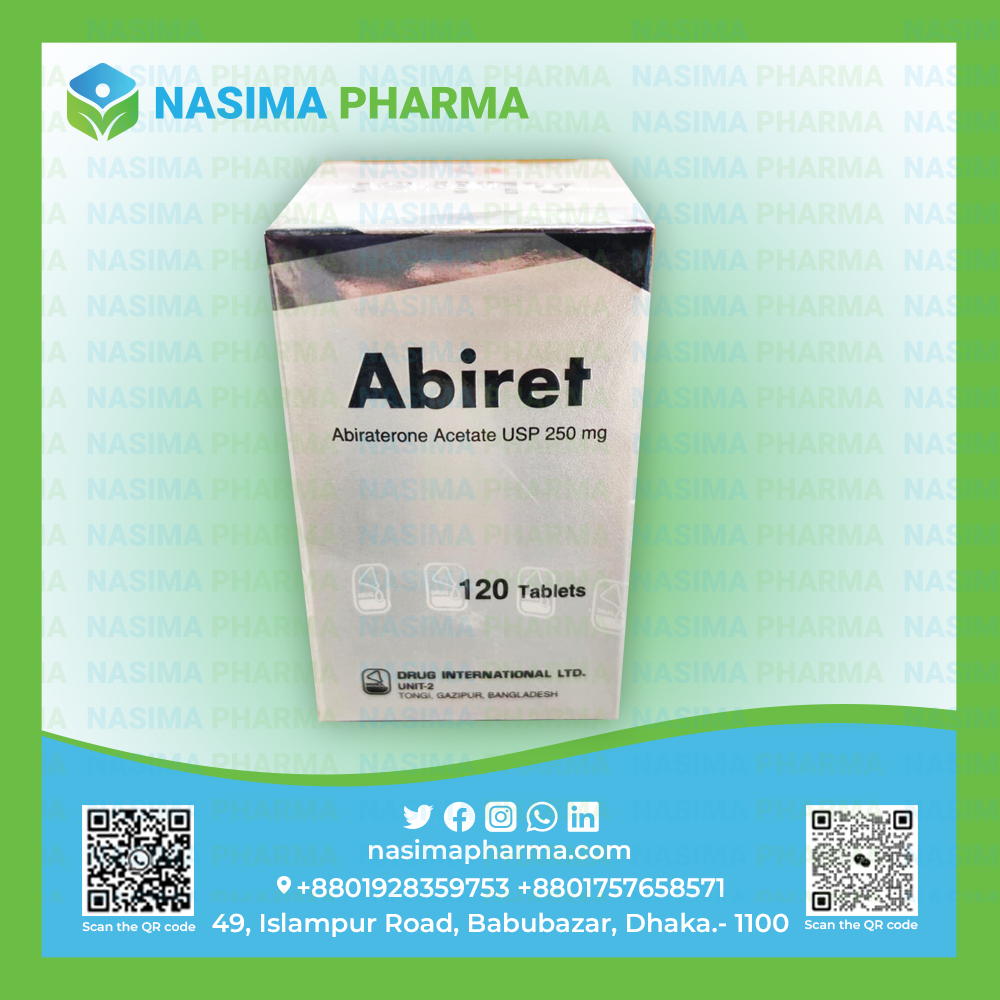
Description
COMPOSITION
Each tablet contains Abiraterone Acetate USP 250mg Tablet.
CLINICAL PHARMACOLOGY
Mechanism of Action:
Abiraterone Acetate is converted in vivo to Abiraterone, an androgen
biosynthesis inhibitor, that inhibits 17 α-hydroxylase/C17, 20-lyase (CYP17).
This enzyme is expressed in testicular, adrenal, and prostatic tumor tissues and
is required for androgen biosynthesis. CYP17 catalyzes two sequential
reactions: 1) the conversion of pregnenolone and progesterone to their 17
α-hydroxy derivatives by 17α-hydroxylase activity and 2) the subsequent
formation of dehydroepiandrosterone (DHEA) and androstenedione,
respectively, by C17, 20 lyase activity. DHEA and androstenedione are
androgens and are precursors of testosterone. Inhibition of CYP17 by
Abiraterone can also result in increased mineralocorticoid production by the
adrenals. Androgen sensitive prostatic carcinoma responds to treatment that
decreases androgen levels. Androgen deprivation therapies, such as treatment
with GnRH agonists or orchiectomy, decrease androgen production in the testes
but do not affect androgen production by the adrenals or in the tumor.
Abiraterone Acetate decreased serum testosterone and other androgens in
patients in the placebo-controlled clinical trial. It is not necessary to monitor the
effect of Abiraterone Acetate on serum testosterone levels. Changes in serum
prostate specific antigen (PSA) levels may be observed but have not been
shown to correlate with clinical benefit in individual patients.
Pharmacokinetics:
Absorption
Following oral administration of Abiraterone Acetate to patients with metastatic
CRPC, the median time to reach maximum plasma Abiraterone concentrations
is 2 hours. Abiraterone accumulation is observed at steady-state, with a 2-fold
higher exposure (steady-state AUC) compared to a single 1,000 mg dose of
Abiraterone Acetate. At the dose of 1,000 mg daily in patients with metastatic
CRPC, steady-state values (mean ± SD) of Cmax were 226 ± 178 ng/mL and of
AUC were 993 ± 639 ng.hr/mL. No major deviation from dose proportionality
was observed in the dose range of 250 mg to 1,000 mg. However, the exposure
was not significantly increased when the dose was doubled from 1,000 to 2,000
mg (8% increase in the mean AUC). Systemic exposure of Abiraterone is
increased when Abiraterone Acetate is administered with food. In healthy
subjects Abiraterone Cmax and AUC 0-∞ were approximately 7- and 5-fold
higher, respectively, when a single dose of Abiraterone Acetate was
administered with a low-fat meal (7% fat, 300 calories) and approximately 17-
and 10-fold higher, respectively, when a single dose of Abiraterone Acetate was
administered with a high-fat (57% fat, 825 calories) meal compared to overnight
fasting. Abiraterone AUC 0-∞ was approximately 7-fold or 1.6-fold higher,
respectively, when a single dose of Abiraterone Acetate was administered 2
hours after or 1 hour before a medium fat meal (25% fat, 491 calories)
compared to overnight fasting. Systemic exposures of Abiraterone in patients
with metastatic CRPC, after repeated dosing of Abiraterone Acetate were similar
when Abiraterone Acetate was taken with low-fat meals for 7 days and
increased approximately 2-fold when taken with high-fat meals for 7 days
compared to when taken at least 2 hours after a meal and at least 1 hour before
a meal for 7 days. Given the normal variation in the content and composition of
meals, taking Abiraterone Acetate with meals has the potential to result in
increased and highly variable exposures. Therefore, Abiraterone Acetate must
be taken on an empty stomach, either one hour before or two hours after a
meal. The tablets should be swallowed whole with water.
Distribution
Abiraterone is highly bound (>99%) to the human plasma proteins, albumin and
alpha-1 acid glycoprotein. The apparent steady-state volume of distribution
(mean ± SD) is 19,669 ± 13,358 L. In vitro studies show that at clinically relevant
concentrations, Abiraterone Acetate and Abiraterone are not substrates of
P-glycoprotein (P-gp) and that Abiraterone Acetate is an inhibitor of P-gp.
Metabolism
Following oral administration of 14 C- Abiraterone Acetate as capsules,
Abiraterone Acetate is hydrolyzed to Abiraterone (active metabolite). The
conversion is likely through esterase activity (the esterases have not been
identified) and is not CYP mediated. The two main circulating metabolites of
Abiraterone in human plasma are Abiraterone Sulphate (inactive) and N-oxide
Abiraterone Sulphate (inactive), which account for about 43% of exposure each.
CYP3A4 and SULT2A1 are the enzymes involved in the formation of N-oxide
Abiraterone Sulphate and SULT2A1 is involved in the formation of Abiraterone
Sulphate.


Reviews
There are no reviews yet.