
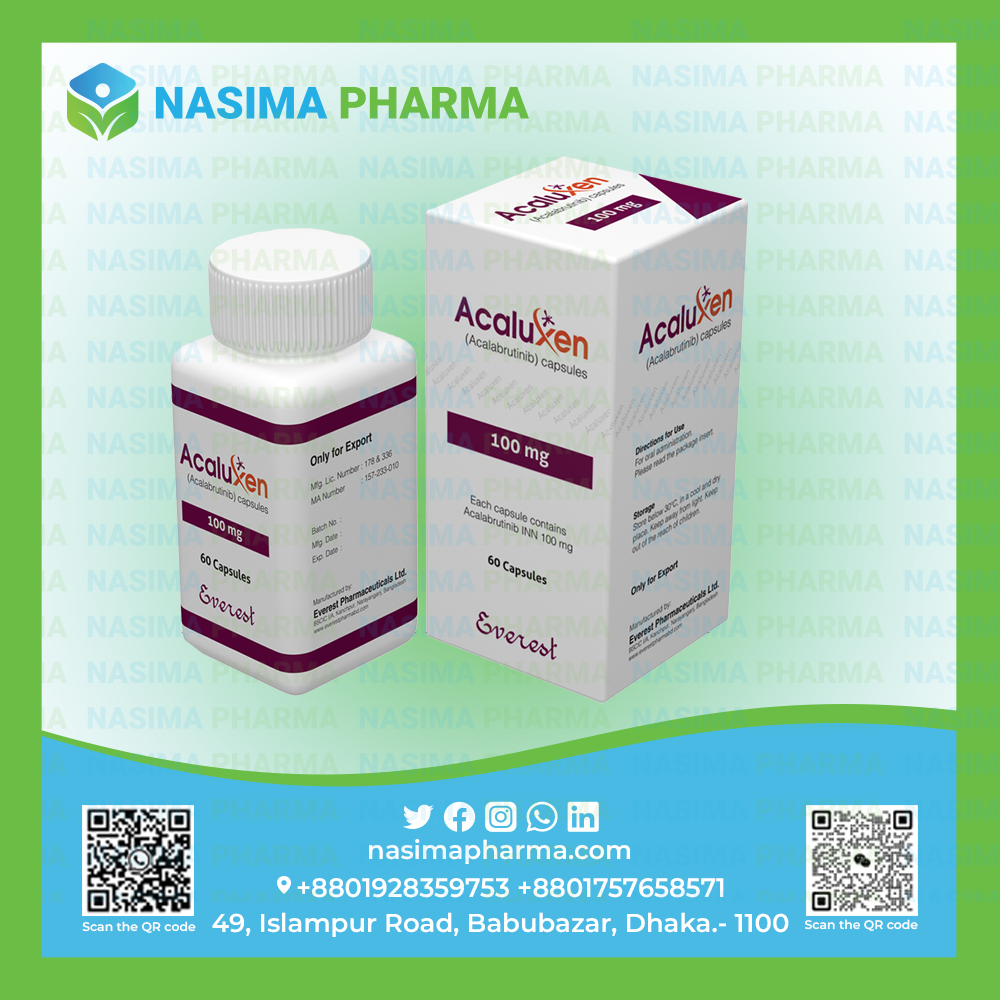
Description
COMPOSITION
Acaluxen capsule: Each capsule contains Acalabrutinib INN
100 mg.
PHARMACOLOGY
Mechanism of Action
Acalabrutinib is a small-molecule inhibitor of BTK. Acalabrutinib and
its active metabolite, ACP-5862, form a covalent bond with a cysteine
residue in the BTK active site, leading to inhibition of BTK enzymatic
activity. BTK is a signaling molecule of the B cell antigen receptor
(BCR) and cytokine receptor pathways. In B cells, BTK signaling
results in activation of pathways necessary for B-cell proliferation,
trafficking, chemotaxis, and adhesion. In nonclinical studies,
Acalabrutinib inhibited BTK- mediated activation of downstream
signaling proteins CD86 and CD69 and inhibited malignant B-cell
proliferation and survival.
Pharmacokinetics
The pharmacokinetics (PK) of Acalabrutinib was studied in healthy
subjects and patients with B-cell malignancies. Acalabrutinib exhibits
almost linear PK across a dose range of 75 to 250 mg (0.75 to 2.5
times the approved recommended single dose) and exhibits
dose-proportionality. The daily area under the plasma drug
concentration over time curve (AUC) was 1111 ng h/mL and
maximum plasma concentration (Cmax) of Acalabrutinib was 323
ng/mL.
Absorption
The geometric mean absolute bioavailability of Acalabrutinib was
25%. Median time to peak Acalabrutinib plasma concentrations
(Tmax) was 0.75 hours.
Effect of food
In healthy subjects, administration of a single 75 mg dose of
Acalabrutinib (0.75 times the approved recommended single dose)
with a high-fat, high-calorie meal (approximately 918 calories, 59
grams carbohydrate, 59 grams fat, and 39 grams protein) did not
affect the mean AUC as compared to dosing under fasted conditions.
Resulting Cmax decreased by 73% and Tmax was delayed 1-2
hours.
Distribution
The geometric mean (CV%) volume of distribution of Dacomitinib
(Vss) was 1889 L (18%). In vitro binding of Dacomitinib to human
plasma proteins is approximately 98% and is independent of drug
concentrations from 250 ng/mL to 1000 ng/mL.
Elimination
Following a single oral dose of 100 mg Acalabrutinib, the median
terminal elimination half-life (t1/2) of Acalabrutinib was 0.9 (range: 0.6
to 2.8) hours. The t1/2 of the active metabolite, ACP-5862, was 6.9
hours.
Acalabrutinib mean apparent oral clearance (CL/F) was 159 L/hr with
similar PK between patients and healthy subjects, based on
population PK analysis.

Reviews
There are no reviews yet.