
Description
Presentation
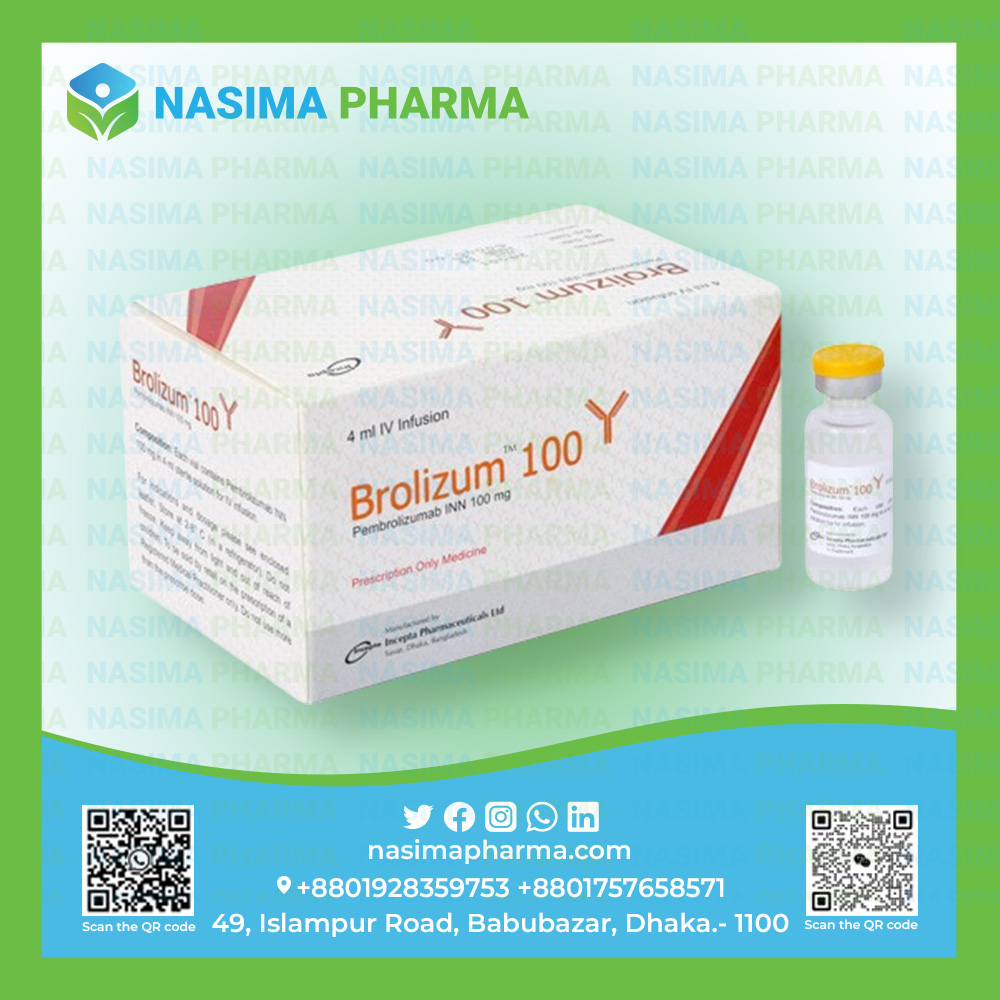
Brolizum 100 IV infusion: Each vial contains Pembrolizumab INN 100 mg in 4 ml sterile solution for IV infusion
Description
Pembrolizumab is a humanized monoclonal antibody used in cancer immunotherapy that treats melanoma, lung cancer, head and neck cancer, Hodgkin lymphoma, stomach cancer, cervical
cancer, and certain types of breast cancer. It binds to and blocks PD-1 located on lymphocytes promoting the immune systems capability to kill cancer cells.
Indications
Pembrolizumab is a programmed death receptor-1 (PD-1)-blocking antibody indicated for:
Melanoma
• The treatment of patients with unresectable or metastatic melanoma.
• The adjuvant treatment of adult and pediatric (12 years and older) patients with Stage IIB, IIC, or III melanoma following complete resection.
Non-Small Cell Lung Cancer (NSCLC)
• The first-line treatment of patients with metastatic non-squamous NSCLC, with no EGFR or ALK genomic tumor aberrations in combination with pemetrexed and platinum chemotherapy.
• The first-line treatment of patients with metastatic squamous NSCLC in combination with carboplatin and either paclitaxel or paclitaxel protein-bound
• The first-line treatment as a single agent for patients with NSCLC expressing PD-L1
• The treatment as a single agent for patients with metastatic NSCLC whose tumors express PD-L1 (TPS ?1%)
Head and Neck Squamous Cell Cancer (HNSCC)
• The first-line treatment of patients with metastatic or with unresectable, recurrent HNSCC in combination with platinum and FU
• The first-line treatment as a single agent for patients with metastatic or with unresectable, recurrent HNSCC whose tumors express PD-L1
• The treatment as a single agent for patients with recurrent or metastatic HNSCC with disease progression on or after platinum-containing chemotherapy Classical Hodgkin Lymphoma (cHL)
• The treatment of adult patients with relapsed or refractory cHL
• The treatment of pediatric patients with refractory cHL, or cHL that has relapsed after 2 or more lines of therapy Primary Mediastinal Large B-Cell Lymphoma (PMBCL)
• The treatment of adult and pediatric patients with refractory PMBCL, or who have relapsed after 2 or more prior lines of therapy Urothelial Carcinoma
• For the treatment of patients with locally advanced or metastatic urothelial carcinoma who are not eligible for any platinum-containing chemotherapy or who have disease progression during or following or within 12 months of neoadjuvant or adjuvant treatment with platinum containing chemotherapy.
• For the treatment of patients with Bacillus Calmette-Guerin (BCG) Microsatellite Instability-High or Mismatch Repair Deficient Cancer
• For the treatment of adult and pediatric patients with unresectable or metastatic, microsatellite instability-high (MSI-H) or mismatch repair deficient (dMMR) solid tumors that have progressed following prior treatment and who have no satisfactory alternative treatment options.
Microsatellite Instability-High or Mismatch Repair Deficient Colorectal Cancer (CRC)
• For the treatment of patients with unresectable or metastatic MSI-H or dMMR colorectal cancer (CRC).
Gastric Cancer
• For the first-line treatment of patients with locally advanced unresectable or metastatic HER2-positive gastric or gastroesophageal junction (GEJ) adenocarcinoma in combination with trastuzumab, fluoropyrimidine- and platinum-containing Chemotherapy.
• For the treatment as a single agent for patients with recurrent locally advanced or metastatic gastric or GEJ adenocarcinoma
Esophageal Cancer
• For the treatment of patients with locally advanced or metastatic esophageal or gastroesophageal junction carcinoma that is not amenable to surgical resection or definitive chemoradiation.
Cervical Cancer
• For the treatment of patients with persistent, recurrent, or metastatic cervical cancer whose tumors express PD-L1 in combination with chemotherapy, with or without Bevacizumab.
• For the treatment as a single agent for patients with recurrent or metastatic cervical cancer with disease progression on or after chemotherapy whose tumors express PD-L1.
Hepatocellular Carcinoma (HCC)
• For the treatment of patients with HCC who have been previously treated with sorafenib. Merkel Cell Carcinoma (MCC)
• For the treatment of adult and pediatric patients with recurrent locally advanced or metastatic
Merkel cell carcinoma.
Endometrial Carcinoma
• For the treatment of patients with advanced endometrial carcinoma that is not MSI-H or dMMR, who have disease progression following prior systemic therapy in any setting and are not candidates for curative surgery or radiation in combination with lenvatinib.
Tumor Mutational Burden-High (TMB-H) Cancer
• For the treatment of adult and pediatric patients with unresectable or metastatic tumor mutational burden-high solid tumors, that have progressed following prior treatment and who have no satisfactory alternative treatment options.
Cutaneous Squamous Cell Carcinoma (cSCC)
• For the treatment of patients with recurrent or metastatic cSCC or locally advanced cSCC that is not curable by surgery or radiation.
Triple-Negative Breast Cancer (TNBC)
• For the treatment of patients with high-risk early-stage TNBC in combination with chemotherapy as neoadjuvant treatment, and then continued as a single agent as adjuvant treatment after surgery.
• For the treatment of patients with locally recurrent unresectable or metastatic TNBC whose tumors express PD-L1 in combination with chemotherapy
Dosage & Administration
• Melanoma: 200 mg every 3 weeks or 400 mg every 6 weeks; 2 mg/kg (up to 200 mg) every 3 weeks for pediatrics.
• NSCLC: 200 mg every 3 weeks or 400 mg every 6 weeks.
• HNSCC: 200 mg every 3 weeks or 400 mg every 6 weeks.
• cHL or PMBCL: 200 mg every 3 weeks or 400 mg every 6 weeks for adults; 2 mg/kg (up to 200 mg) every 3 weeks for pediatrics.
• Urothelial Carcinoma: 200 mg every 3 weeks or 400 mg every 6 weeks.
• MSI-H or dMMR Cancer: 200 mg every 3 weeks or 400 mg every 6 weeks for adults; 2 mg/kg (up to 200 mg) every 3 weeks for pediatrics.
• MSI-H or dMMR CRC: 200 mg every 3 weeks or 400 mg every 6 weeks.
• Gastric Cancer: 200 mg every 3 weeks or 400 mg every 6 weeks.
• Esophageal Cancer: 200 mg every 3 weeks or 400 mg every 6 weeks.
• Cervical Cancer: 200 mg every 3 weeks or 400 mg every 6 weeks.
• HCC: 200 mg every 3 weeks or 400 mg every 6 weeks.
• MCC: 200 mg every 3 weeks or 400 mg every 6 weeks for adults; 2 mg/kg (up to 200 mg) every
3 weeks for pediatrics.
• RCC: 200 mg every 3 weeks or 400 mg every 6 weeks as a single agent in the adjuvant setting,
or in the advanced setting with either axitinib 5 mg orally twice daily or lenvatinib 20 mg orally once daily.
• Endometrial Carcinoma: 200 mg every 3 weeks or 400 mg ever 6 weeks with lenvatinib 20 mg orally once daily.
Side Effects
Most common adverse reactions (reported in ?20% of patients): fatigue, musculoskeletal pain, rash, diarrhea, pyrexia, cough, decreased appetite, pruritus, dyspnea, constipation, pain, abdominal pain, nausea, hypothyroidism, vomiting, alopecia, peripheral neuropathy, mucosal
inflammation, stomatitis, headache, weight loss, arthralgia,myalgia, neutropenia, insomnia, anemia, fatigue/asthenia, hypertension, thrombocytopenia, urinary tract infection, leukopenia, hepatotoxicity, palmar-plantar erythrodysesthesia, proteinuria, hemorrhagic events,
hepatotoxicity, and acute kidney injury
Precautions
• Immune-Mediated Adverse Reactions-May be severe or fatal. Should monitor for early identification and management. Should evaluate liver enzymes, creatinine, and thyroid function
at baseline and periodically during treatment. Recommended to withhold or permanently discontinue based on severity and type of reaction.
• Infusion-related reactions-Should interrupt, slow the rate of infusion, or permanently discontinue Pembrolizumab based on the severity of reaction.
• Complications of allogeneic HSCT-Fatal and other serious complications can occur in patients who receive allogeneic HSCT before or after being treated with a PD-1/PD-L1 blocking antibody.
• Treatment of patients with multiple myeloma with a PD-1 or PD-L1 blocking antibody in combination with a thalidomide analogue plus dexamethasone is not recommended outside of
controlled clinical trials.
• Embryo-Fetal toxicity-Can cause fetal harm. Females reproductive potential should be advised
of the potential risk to a fetus and to use effective method of contraception
Use in Pregnancy & Lactation
Use in specific population
Pregnancy & Lactation: Based on animal data, may cause fetal harm. Discontinue drug or nursing taking into consideration importance of drug to mother.
Pediatric Use: The safety and effectiveness of Pembrolizumab as a single agent have been established in pediatric patients with melanoma, cHL, PMBCL, MCC, MSI-H or dMMR cancer,
and TMB-H cancer.
Geriatric Use: No overall differences in safety or effectiveness were observed between elderly patients and younger patients.
Hepatic Impairment: No clinically important effect was observed in patients with mild hepatic impairment. The impact on moderate to severe hepatic impairment is unknown.
Renal Impairment: No clinically important effect was observed in patients with renal impairment


Reviews
There are no reviews yet.